Why Grading and Drainage Matter More Than You Think
Across Pittsburgh and Westmoreland County, homeowners are coming outside to breathe the fresh spring air; they’re walking their yards with a cup of coffee, looking at that cracked driveway, the sunken patio, and the slouching retaining wall, the muddy patch in the middle of the yard. Summer is coming. It’s project season.
Maybe you’ve called a contractor and already have three quotes sitting on the kitchen counter. Maybe you’re picking finishes and stamp patterns right now.
Before you sign anything, stop for a moment. Consider why the retaining wall is bowing, the patio is off kilter, and the driveway is cracked. It’s probably all about water. It’s the question homeowners never think to ask: where is that water coming from and where is it going?
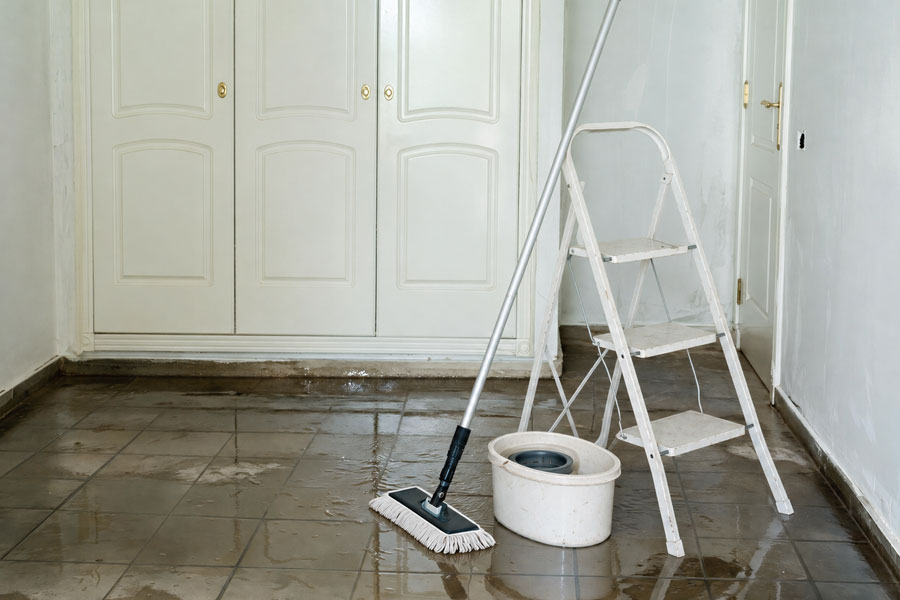
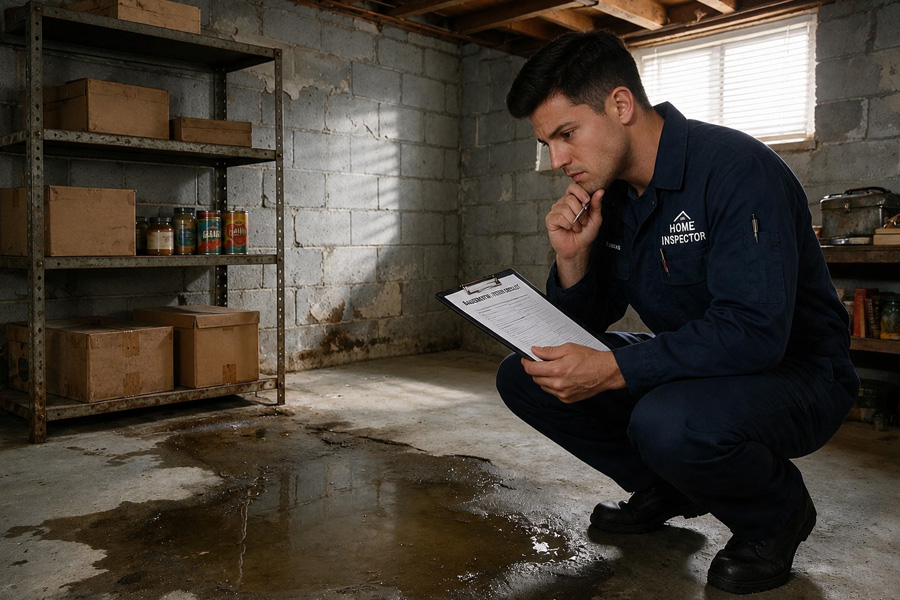
The answer to that question decides whether your new driveway lasts 20 years or cracks apart in five. It decides whether your patio drains cleanly or turns into an ice rink every February. And (this is the part to keep in mind) it decides whether your basement stays dry or starts leaking next spring.
The Part Most Contractors Don’t Talk About
Concrete contractors and landscapers do beautiful work. They pour smooth slabs. They lay handsome pavers. They stack retaining walls that make your yard look like a magazine.
What some often skip (or rush through) is what our team at D-Bug Waterproofing think is the most important part, the foundation of a successful project. That’s the soil, the grade, and the subsurface drainage.
Here’s the hard truth about outdoor concrete work: the job you see on the surface only matters if the work underneath was done right. A patio with a perfect stamped finish fails fast if the ground below was not graded and compacted. A driveway that looks flawless on installation day can crack, sink, and pool water within a single winter if drainage was not part of the plan.
Most outdoor concrete failures trace back to the same three causes:
- Poor soil compaction under the slab
- Wrong slope (called grading) across the surface
- No subsurface drainage to move water away
None of those show up in photos. All of them show up as problems eventually.
Why Grading Matters More Than You Think
Grading is the slope of the ground (or the slope of a finished concrete surface). It sounds boring. It is the single most important decision on any outdoor project.
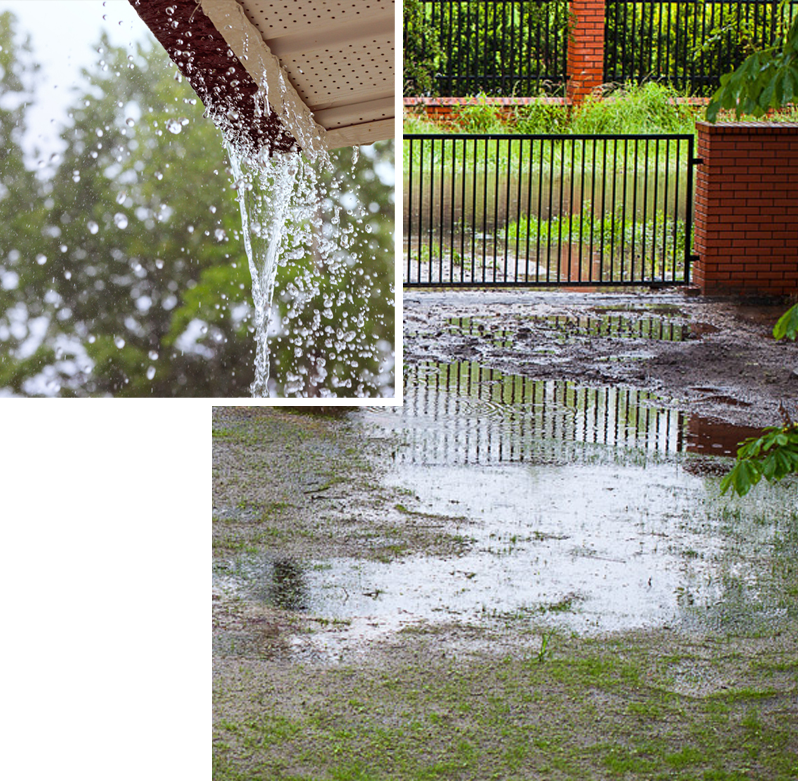
Think about what water does when it lands on your driveway, your patio, or the ground beside your retaining wall. It does not stay put. It moves. Gravity pulls it downhill, and it follows whatever path the ground gives it.
If the ground slopes away from your house, water drains toward the street, the yard, or a catch basin. Everything stays dry.
If the ground slopes toward your house (even slightly), water runs straight at your foundation. Even worse, if it pools against your basement or under your patio or driveway, winter freeze/thaw cycles will act like a jackhammer against your foundation or concrete work.
Building codes and best practices agree on the target: the ground should drop at least six inches over the first ten feet away from the foundation. That small slope adds up to thousands of gallons of water redirected away from your basement each year.
When a contractor pours a patio or driveway without checking this slope first, the finished project can lock bad drainage in place for decades. The concrete may look fine. The water underneath tells a different story.
How Bad Outdoor Concrete Causes Basement Problems
Here is how it works in a typical Western PA yard.
The settled driveway. A concrete driveway may settle unevenly over time. Low spots form near the house. Rainwater pools there instead of running to the street. That water soaks into the soil right next to your foundation, adding hydrostatic pressure against your basement wall.
The pitched-wrong patio. A patio was poured flush with the back door, level or sloping slightly toward the house. Every storm sends a sheet of water across that patio and directly against the siding and foundation. You may never see the water enter. You will see the damp basement wall eventually.
The retaining wall without drainage. A retaining wall holds back tons of soil. That soil holds water. Without a drainage system behind the wall (a French drain, a gravel backfill, weep holes, or all three), water builds up and pushes against the wall. Eventually the wall bows, cracks, or tips. The water it was holding back now flows straight toward whatever is downhill, which is often your home.
Each of these problems can send thousands of gallons of water toward your foundation every year. Your basement pays the price.
What Concrete Contractors Shouldn’t Skip
Not every contractor is thinking about water. Many are thinking about the slab: mix, pour, finish, cure. That is their job, and they are good at it.
The items that get skipped (or underplayed) tend to be the ones a homeowner cannot see after the job is done:
- Soil compaction. Loose fill settles. Settled fill cracks the slab above it.
- Sub-base drainage. A proper stone base lets water pass through instead of trapping it under the concrete.
- Catch basins at low points. These drains grab surface water and carry it away before it finds your foundation.
- French drains behind retaining walls. A buried perforated pipe relieves water pressure behind the wall before it builds up.
- Downspout lead-offs. Buried pipes carry roof water from the downspout to a safe discharge point in the yard, not into the dirt next to your foundation.
- Final grade around the project. The last step (and often the skipped one): making sure the finished ground slopes away from the house.
When those pieces are missing, the beautiful concrete work may be in trouble from day one.
Pittsburgh-Specific Challenges: Why We Cannot Ignore This
Outdoor drainage matters everywhere. In Westmoreland County communities and throughout Western Pennsylvania, it matters more.
Clay-heavy soil. Our soil holds water like a sponge. It swells when wet and shrinks when dry. Both motions push and pull on concrete slabs and retaining walls.
Hilly terrain. Pittsburgh and Westmoreland County sit on hills. Water does not just fall on your property. It runs onto your property from every uphill neighbor. Your grading has to handle more water than the rain alone.
Freeze-thaw cycles. Water that pools in winter freezes and expands. That expansion breaks concrete from the inside out. One bad drainage detail becomes a crack by March.
Older housing stock. Many homes here were built decades ago, before modern drainage standards. Old driveways, old patios, and old retaining walls often sit next to foundations that were not waterproofed either. Adding new concrete without fixing the drainage just locks the old problem in place.
Generic “pour it flat and call it done” concrete work does not survive here. Our region demands a plan for water.
D-Bug’s Outdoor Services (Built on 45+ Years of Water Knowledge)
D-Bug Waterproofing has handled basement water problems in Western PA since 1980. Over that time, we learned something important: the fastest way to keep a basement dry is to stop water before it ever reaches the foundation.
That is why we offer full outdoor services, and why we approach each one as a waterproofing project first and a concrete project second.
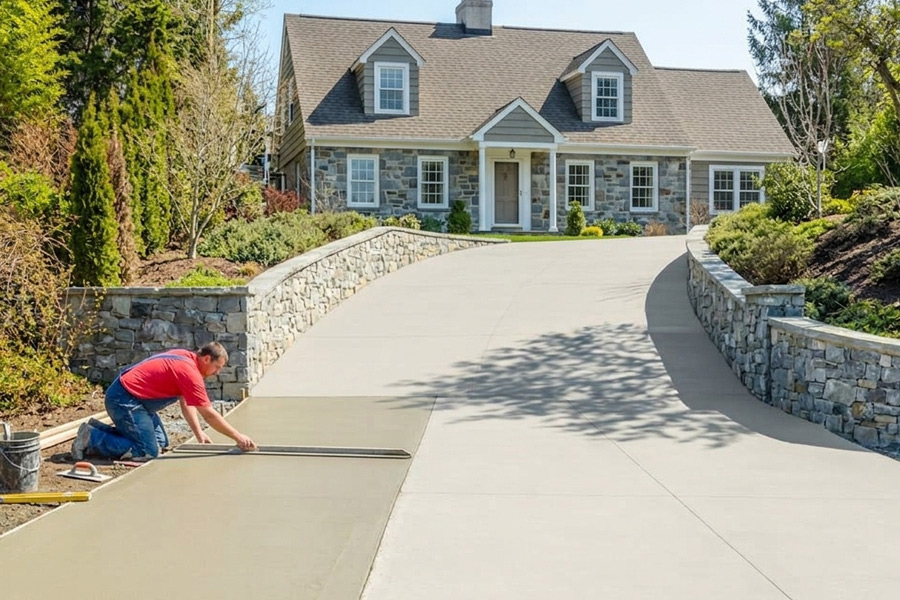
Concrete driveways. We install driveways with proper sub-base preparation, controlled slopes, and attention to where runoff ends up. No low spots by the garage. No water heading for the basement.
Concrete finishing. Sidewalks, porches, steps, and patio floors get the same treatment: soil prep first, pitch second, finish third. The pretty part is the last step, not the only step.
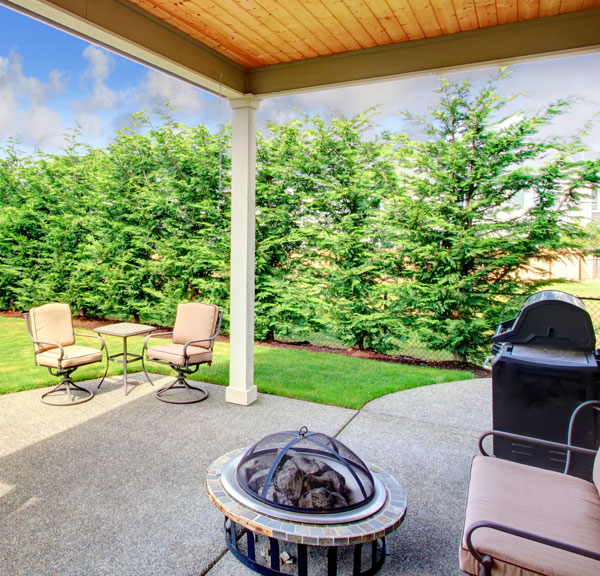
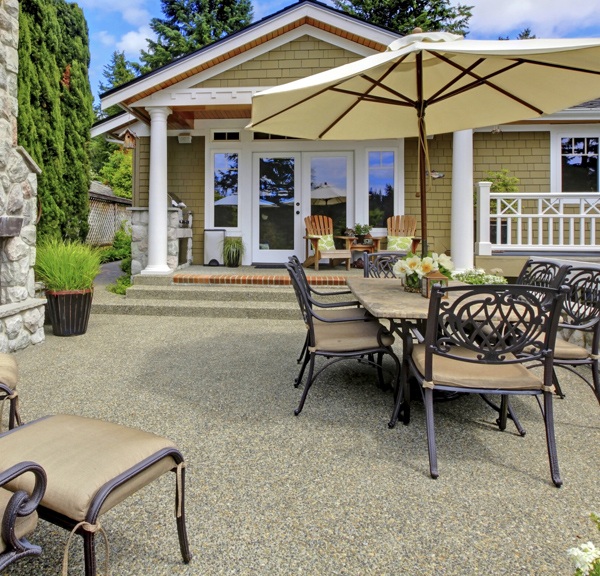
Patio design and installation. We design patios that fit your yard and drain the way they should. That means pitching the slab away from the house and planning where the water goes when it leaves the patio.
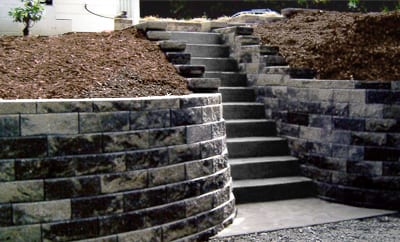
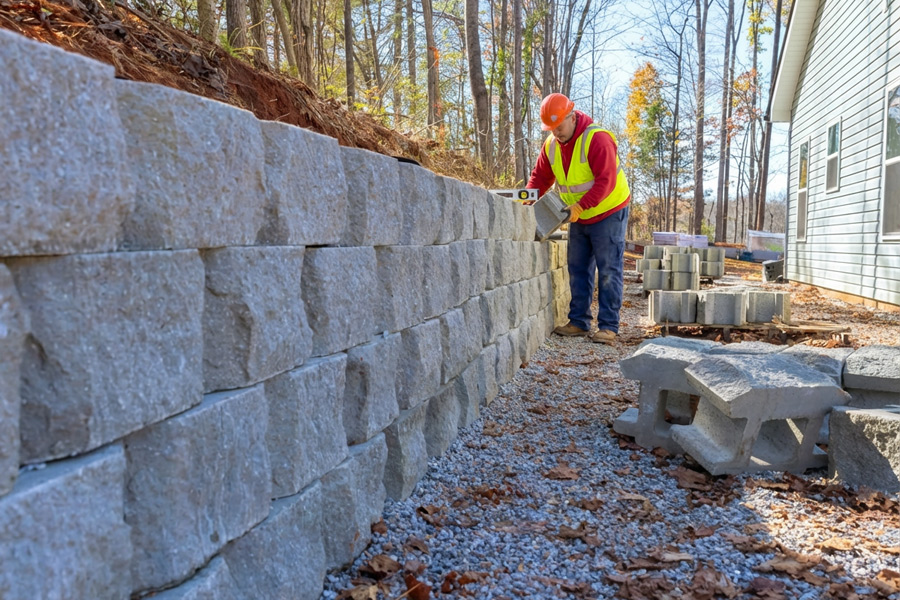
Versa-Lok retaining walls. We build retaining walls using the Versa-Lok block system, and we build them with drainage behind the wall: gravel backfill, perforated drain pipe, and weep holes where needed. The wall holds back the soil. The drainage handles the water.
Excavation and regrading. We re-shape yards so the ground sheds water the way it is supposed to. That sometimes means moving a lot of dirt. It always means your home stops sitting in a puddle.
Catch basins and downspout lead-offs. When a yard collects water faster than it can drain, we add catch basins and buried lead-offs to carry the water to a safe exit point.
Why a Waterproofing Company Is the Right Choice
A good concrete contractor builds what you see. A good landscaper makes what you see beautiful. Both can do fine work. But at D-Bug Waterproofing, we bring the experience to handle the things you see and the things you don’t. We manages what you don’t: the water moving through the soil under and around every surface of your property.
When you hire D-Bug for a driveway, a patio, or a retaining wall, you are not hiring a crew that will pour concrete and leave. You are hiring a team that has spent 45+ years watching what happens to homes when outdoor drainage goes wrong. We plan every project with your basement in mind, because we have been inside thousands of basements that paid for someone else’s missed detail.
We are family-owned. Our crews are our own (no subcontractors). We have served the Pittsburgh and Westmoreland County area the same way since 1980: one neighborhood, one home, one honest job at a time.
Plan the Whole Project, Not Just the Surface
Spring is the right season to start. Summer is the season to build. Don’t let this year’s project become next year’s basement problem.
Before you sign a contract for a new driveway, patio, or retaining wall, get a second opinion from a company that thinks about water first. A free D-Bug evaluation covers grading, drainage, soil conditions, and how the project connects (or doesn’t) to the long-term health of your foundation.
Schedule your free evaluation today by calling 1-855-381-1528 or contact us online. Build it once. Build it right. And keep your basement dry while you’re at it.