
Is your basement wall bowing inward? Maybe it bulges in the middle. Maybe a long horizontal crack runs across the block. Maybe the wall simply looks like it is leaning into the room.
That wall is being pushed from outside. Wall anchors push back.
Why Basement Walls Bow in Western Pennsylvania
Our soil works against foundations. Heavy clay swells when it gets wet and presses on the block. Hilly ground sends rainwater downhill toward houses built on slopes. Then winter arrives, and every freeze-thaw cycle opens the cracks a little wider.
A block wall can carry that pressure for years. Eventually it gives. The wall bows first, then cracks, then starts to slide at the mortar joints.
Signs your wall is under pressure:
- A horizontal crack running the length of the wall
- Block that bulges inward, usually near the middle
- Stair-step cracks following the mortar joints
- A wall that leans in at the top or slides at the bottom
- Cracks that keep getting wider month to month
How Wall Anchors Work
A wall anchor holds your wall from both sides.
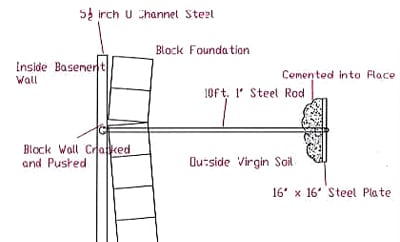
We dig out to undisturbed soil well beyond the foundation and set a steel plate there. Inside the basement, we place a matching plate against the wall. A steel rod runs between the two, through the wall and out to the anchor.
Tightening that rod does two things. It stops the wall from moving any further. Over the following months, as the soil outside relaxes, the rod can draw the wall back toward straight.
This is a structural repair, not a cosmetic patch.
Our Plates Are Bigger
Most anchor systems use a small square plate. We use a 16 by 16 inch steel plate.
That difference matters more than it sounds. A larger plate spreads the load across more soil and more block. A small plate concentrates pressure in one spot, which is what damaged the wall in the first place.
What the Work Looks Like
We keep the digging tight. Wall anchors need a limited excavation at each anchor point, not a trench around your whole house. Most yards recover quickly.
Our own trained employees do the work. D-Bug does not subcontract foundation repair.
When Anchors Are Not Enough
Some walls have moved too far for anchors to correct. If the bottom row of block has slid off the footer, or the wall has pushed in badly, we use steel I-beam supports or rebuild the wall instead.
We will tell you straight which one your wall needs. Anchoring a wall that is too far gone wastes your money. Either way, it starts with someone looking at the foundation in person.
Get It Looked At
Bowing walls do not settle down on their own. The pressure that pushed the wall in is still out there pushing.
D-Bug Waterproofing has repaired foundations across Western Pennsylvania since 1980. We serve Pittsburgh, Greensburg, Latrobe, Irwin, and communities throughout Westmoreland County and the surrounding region.
Call 1-855-381-1528 or visit our Contact Us page for a free inspection. We will look at your wall and tell you what it needs.